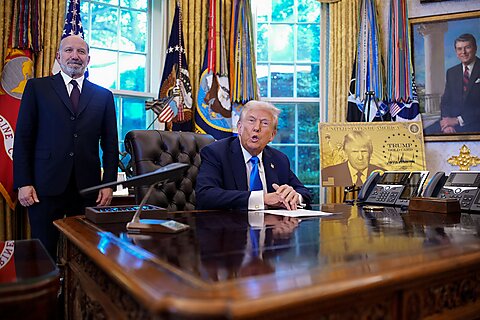

President Trump first mused about a US Sovereign Wealth Fund during his 2024 presidential campaign. Shortly after taking office, he signed an executive order instructing his Treasury and Commerce secretaries to design such a fund.
Those plans would ultimately stall, but as we summarized in August, what we’ve seen instead is a wave of ad hoc stakes and revenue shares wrested from US companies like US Steel, Nvidia, and AMD, and most famously, Intel. Trump advisers pledged to continue their interventionist tear, and just this week, Trump announced the country will take a 10 percent stake in the Canadian mining company Trilogy Metals and fast-track permit approval for an Alaskan mining road the company stands to benefit from.
A survey of top finance economists by the Kent Clark survey group warns that this strategy tends to backfire, even for the individual firm. A large majority of economists surveyed think government ownership of equity stakes is detrimental to corporate performance and governance.
On the performance question, 46 percent agreed or strongly agreed that such stakes are measurably detrimental to corporate performance. When weighted based on respondents’ confidence, 67 percent agreed, and only 7 percent disagreed. In other words, economists overwhelmingly see partial public ownership as a drag on a firm’s ability to compete and grow.
At one level, the strength of this majority might seem surprising. When governments have an ownership stake, they have an incentive to use government powers to protect their investment. After the government took stakes in Intel and Trilogy Metals, their stock prices soared as investors anticipated greater profits from the partnership. Whether it’s the expectation of political protection from shocks, the government using its powers to force others to procure from the company, or other measures to strengthen the firm’s balance sheet, one could imagine all sorts of ways a government could prop up its own investment while sullying competition and misallocating capital in aggregate.
Dr. Amit Seru of Stanford notes, for example, that “governments may bend regulations to bolster the performance of companies they partly own, offsetting any drag from weak governance.” In theory, as Dr. Jonathan Parker of MIT added, an “initial investment could be preferential or detrimental.” It’s ambiguous.
The potential upsides for the firm affected make the result here even more damning—a clear majority still thinks a government stake will be detrimental to longer-run performance.
Why? State backing could act as infinite life support for a zombie company or overinvestment in uneconomic projects. Investment and hiring decisions risk being influenced by political constraints rather than the bottom line. Government owners may put explicit or implicit pressure on managers to save the company’s workforce (potential voters, remember) or plants from market-led creative destruction. Slower decisions and more perceived veto points will lead to decisions that raise costs or quell innovation, all making major strategic pivots for the firm harder. For all these reasons, economists don’t just think that government equity risks misallocating capital overall; it’ll likely damage the individual firm’s long-run profitability as well.
True, a sovereign wealth fund with low stakes in individual firms and no voting rights would probably have little effect on corporate performance either way. But in context, that’s clearly not what this president has in mind. All the president’s rhetoric suggests he’d be an activist investor, despite promises to the contrary. Commerce Secretary Howard Lutnick admits that the whole point of taking a Golden Share in US Steel is to prevent it from undertaking certain business decisions without the president’s approval.
Even under another president who might earnestly pledge not to interfere with business decisions, robust checks would be needed to ensure the president can resist the siren’s call during times of slumped economic activity or political pressure. If it were most profitable for US Steel to move jobs out of Pennsylvania, could any president be trusted to sit idly by? What if it were an election year? “Even a formally ‘passive’ form of ownership,” Booth School Professor Stefan Nagel added to his survey response, “is unlikely to prevent political interference.”
Government ownership fared even worse on the question of corporate governance outcomes. Nearly 60 percent of the surveyed economists agreed the government equity stakes would be “substantially detrimental to good corporate governance,” while only 3 percent disagreed. Weighting by confidence pushed agreement up to 82 percent.
The dynamic here is clearer: a firm partly owned by the state must answer not only to its ordinary investors but also to shifting political agendas, a recipe for blurred accountability and rampant rent-seeking. Effective governance is bound to suffer when decisions are subject to such lobbying and businesses are serving two gods.
Taken together, these surveys highlight how economists distrust attempts to merge political and commercial goals. Just as most economists oppose price controls that distort market incentives, they view government ownership stakes as a threat to the market discipline that makes firms productive and innovative. In terms of both performance and governance, government shareholders rarely leave a company in a better position.