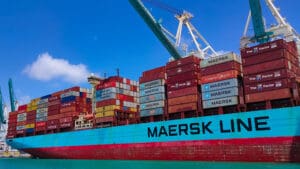
Global shipping giant Maersk has suspended operations at the Port of Salalah in Oman after a drone attack struck oil storage facilities at the strategic logistics hub, intensifying concerns about global trade disruption as the conflict involving Iran spreads across the Gulf.
The Danish shipping group said it had paused activity at the port “until further notice” following what it described as an ongoing security incident near the facility’s general cargo terminal. The move comes as the war in the region increasingly threatens major shipping routes and energy infrastructure across the Middle East.

The Port of Salalah, located on Oman’s southern coast, is one of the region’s most important maritime gateways and had been widely regarded as a relatively safe alternative for shipping companies seeking to avoid the escalating risks around the Strait of Hormuz and the Red Sea.
The port sits at a critical intersection of global trade routes linking southeast Asia with Europe, Africa and the Americas. Since opening in 1998 it has handled more than 50 million containers and over 100 million metric tonnes of cargo, and it recently completed a $300 million upgrade to its container terminal designed to increase capacity and efficiency.
Historically, Oman has promoted the port’s location in a politically neutral country as a major advantage for global shipping operators. The country has long positioned itself as a diplomatic mediator in regional disputes, maintaining working relationships with both Western governments and Iran.
However, the drone strike has now brought the conflict directly to Oman’s shores, raising fears that the war is expanding to new fronts and threatening infrastructure that had previously been viewed as relatively insulated from the fighting.
Images from the port showed thick plumes of smoke rising from fuel storage facilities after the attack triggered a fire in oil tanks. Omani authorities confirmed they were working to contain the blaze but said oil supply continuity had not been disrupted.
The incident is the latest in a series of attacks targeting energy infrastructure and maritime assets across the Gulf region. Earlier this week, falling debris from an intercepted drone sparked a fire that damaged storage infrastructure at Fujairah, a major ship refuelling hub in the United Arab Emirates.
Container shipping has also been affected directly. The Japan-flagged vessel One Majesty sustained minor damage after being struck by an unidentified projectile approximately 25 miles northwest of the UAE.
Maersk said the escalating instability has forced it to adapt operations across its network. The company confirmed that it was redistributing maritime fuel supplies to ensure vessels can continue to refuel and operate despite the growing disruption to storage facilities and fuel distribution infrastructure in the region.
A spokesperson for the company said the measures were designed to ensure that its global shipping network could continue functioning.
“We are proactively redistributing fuel to ensure vessels can continue to bunker where needed and keep our ocean network running without interruptions,” the company said.
The conflict has already left large numbers of ships stranded across the Gulf. Maersk alone has ten vessels currently trapped in the region, while industry estimates suggest roughly 100 container ships are unable to move through key routes.
German shipping group Hapag-Lloyd has also reported that a number of its vessels remain stuck in the Strait of Hormuz as tensions escalate.
In response to the heightened risks, Maersk and other carriers have suspended most new cargo bookings to and from several Gulf countries, including the United Arab Emirates, Oman, Qatar and Saudi Arabia.
The escalation comes as Iran continues its blockade of the Strait of Hormuz, one of the most critical maritime chokepoints in the global energy system. Roughly one-fifth of the world’s oil exports typically pass through the narrow waterway, which connects the Persian Gulf with the Indian Ocean.
Iran’s leadership has signalled that it intends to maintain pressure on global shipping lanes as the conflict intensifies. Mojtaba Khamenei, Iran’s new leader, said this week that Iranian forces would continue enforcing restrictions on traffic through the strait.
Analysts believe the strategy is designed to maximise economic pressure on Western and Gulf nations by disrupting oil and commercial shipping flows.
Danny Citrinowicz, a fellow at the Atlantic Council and a former Israeli military intelligence officer specialising in Iran, said Tehran was likely to escalate further attacks on infrastructure.
“They will raise the bar by targeting more infrastructure,” he said. “The goal is to inflict economic damage and demonstrate that countries supporting the war will face serious consequences.”
The attacks have now affected every member state of the Gulf Cooperation Council as well as Iraq, which has already been forced to shut down parts of its oil production infrastructure due to security concerns.
Oman itself has taken precautionary measures by moving vessels away from its key oil export terminal at Mina al Fahal while authorities assess the security situation.
Another Omani port, Duqm, located roughly 500 kilometres south of the capital Muscat, was also struck during the early stages of the conflict.
Despite Iran’s increasingly aggressive strategy, Iranian officials have denied responsibility for the attack on Salalah. Tehran described Oman as a “friend and neighbour” and suggested that the strike could have been carried out by other actors seeking to widen the conflict and frame Iran.
However, the expansion of attacks across multiple countries has heightened fears among global shipping companies that the war could effectively choke off two of the world’s most vital maritime corridors.
In addition to the disruption in the Strait of Hormuz, Iran’s Houthi allies in Yemen have previously attacked shipping in the Red Sea during the Gaza conflict. Analysts warn they could resume those attacks if the conflict escalates further.
If that occurs simultaneously with the closure of Hormuz, the global shipping industry could face unprecedented disruption to both oil and container trade flows between Asia, Europe and the Americas.
For global logistics networks already strained by geopolitical tensions and supply chain volatility, the suspension of operations at Salalah underscores how rapidly the conflict is spreading beyond traditional battle zones and into the infrastructure that underpins international trade.
Read more:
Maersk halts operations at Oman port after drone strike widens Iran conflict disruption