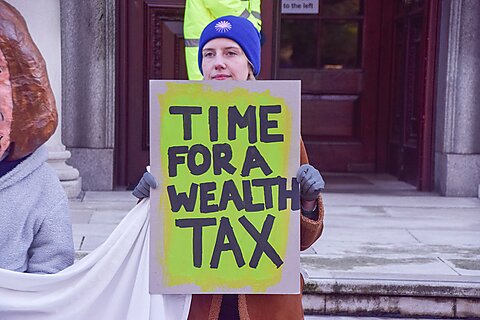

I recently covered some of the economic, administrative, and historical problems with wealth taxes in my piece, “The Return of the Wealth Tax, Evidence Against Them Is Stronger Than Ever.” I focused on the pending California ballot initiative for a one-time 5 percent wealth tax on the state’s billionaires.
Since then, the debate has expanded to the national level with a new proposal from Senator Bernie Sanders and Representative Ro Khanna.
Two related points stand out from the growing body of analysis. First, wealth-tax proponents consistently overstate how much revenue these taxes would raise. Second, the broader political project behind these proposals may be intentionally obscuring the intractable arithmetic of rising government deficits.
Revenue Reality
Historically, wealth taxes have raised little revenue and routinely underperformed official projections. The same dynamic appears likely to repeat itself in the United States.
A recent analysis by five Stanford economists at the Hoover Institution examines the proposed California wealth tax and finds that its projected $100 billion in revenues relies on unrealistic assumptions. After correcting key methodological problems, the authors estimate that the one-time tax would raise $40 billion. That’s 60 percent less than claimed.
Even that estimate is not complete. If wealthy Californians respond by relocating—as we’ve already seen—the tax could actually reduce total state revenue. Under plausible assumptions about taxpayer mobility, the authors estimate that California could lose $25 billion in net revenue once foregone income tax collections are taken into account.
And these estimates still assume that behavioral responses are limited to the small number of taxpayers directly subject to the wealth tax. In reality, taxpayers just below the threshold will also respond. Given California’s ongoing fiscal pressures and its willingness to pursue highly aggressive taxation of higher-income taxpayers, it would be rational for entrepreneurs and investors to anticipate that future taxes could expand further down the income distribution. Additional outmigration among the sub-billionaire or aspiring billionaire demographic would deepen the state’s net fiscal losses from the wealth tax.
The same pattern appears in the Sanders-Khanna federal wealth tax, which the lawmakers claim would raise $4.4 trillion over a decade. Applying widely accepted estimates of behavioral responses, Kyle Pomerleau finds the tax would raise closer to $2.3 trillion, about half the lawmaker’s claim. Accounting more fully for broader economic effects and lower income-tax collections would further reduce net federal revenue.
The Real Fiscal Goal
The Sanders-Khanna proposal would use the projected wealth-tax revenue to fund a long list of new federal programs, including direct payments to households making less than $150,000, expansions to Medicaid, Medicare and Affordable Care Act subsidies, childcare subsidies, housing programs, and public school salaries.
What the proposal notably does not do is address the federal deficit, which is projected to rise from $2 trillion to $3 trillion per year by 2036. A decade of revenue from the proposed wealth tax would barely fund one year of the average federal deficit (the annual gap between revenue and outlays) over the budget window. Even the most punitive and far-reaching “tax-the-rich” proposals are not serious tools for fiscal stabilization.
Instead, as I’ve written many times before, the way every other large social welfare state pays for its high levels of spending is primarily with broad-based income and consumption taxes on people at every income level. High-income taxpayers simply do not represent a large enough or stable enough tax base to support European-style spending levels.
Wealth taxes and other similarly narrow tax-the-rich proposals at best obscure the true cost of expanding government. At worst, they intentionally mislead voters into believing that someone else can foot the bill for an expansive government.
If policymakers want a larger government, they should be honest about how it will have to be financed. There is no painless or politically convenient substitute for confronting the real drivers of federal spending and growing deficits.