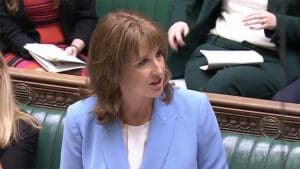
Chancellor Rachel Reeves delivered her Spring Statement to the House of Commons under the shadow of escalating conflict in the Middle East and mounting fears of a renewed inflation shock driven by surging energy prices.
In a speech lasting just over 20 minutes, Reeves stressed the importance of “stability in an increasingly uncertain world”, pointing to falling inflation and previous interest rate cuts as evidence that the cost-of-living squeeze on households is easing. However, beyond presenting updated forecasts from the Office for Budget Responsibility (OBR) and criticising opposition parties, she unveiled no new tax or spending measures.

The Chancellor has pledged to hold only one fiscal event each year, the autumn Budget, meaning the Spring Statement was positioned as a forecast update rather than a policy platform.
Growth downgraded for 2026
The OBR has revised down its forecast for UK economic growth in 2026 to 1.1 per cent, weaker than the 1.4 per cent predicted in November. Reeves insisted that the longer-term outlook remains resilient, with growth forecast to reach 1.6 per cent in both 2027 and 2028, slightly stronger than previously projected, before settling at 1.5 per cent in 2029 and 2030.
The downgrade comes amid soft domestic demand, geopolitical instability and renewed energy market volatility following military escalation in the Gulf region. Rising oil and gas prices threaten to complicate the inflation trajectory, particularly if disruption to global supply chains persists.
Unemployment to rise before falling
Unemployment is forecast to peak at 5.3 per cent later this year as weaker labour demand feeds through the economy. The rate is then expected to decline steadily, ending the parliamentary term at 4.1 per cent, lower than at the start.
The Chancellor framed this as evidence that the labour market remains fundamentally strong despite short-term headwinds. However, youth unemployment and business hiring caution remain key concerns across several sectors.
Borrowing falls and headroom improves
The OBR forecasts that borrowing will be nearly £18 billion lower than anticipated in the autumn. Public sector net borrowing is projected to decline from 4.3 per cent of GDP this year to 1.8 per cent by 2030.
Reeves highlighted that fiscal “headroom” against her self-imposed rules has increased from £21.7 billion in November to £23.6 billion. The buffer is designed to reassure financial markets and protect against unexpected shocks.
She also confirmed plans to meet North Sea energy industry leaders to discuss the implications of Middle East tensions on domestic production and energy security.
Night-time economy: “Stability rhetoric won’t save us”
Despite the Chancellor’s emphasis on stability, business leaders were quick to challenge what they described as a disconnect between Westminster messaging and frontline reality.
Michael Kill, chief executive of the Night Time Industries Association (NTIA), said the statement failed to recognise the acute pressures facing hospitality and leisure businesses.
“Across the UK, major brands and corporates are collapsing at pace. Confidence is fragile. Margins are exhausted,” he said.
Kill warned that escalating energy costs, higher National Insurance contributions and ongoing business rates burdens are placing “compounding pressure” on the sector. He called for a VAT cut for hospitality, arguing that targeted intervention would stimulate demand, protect jobs and restore confidence.
With youth unemployment rising, the NTIA stressed that the night-time economy has traditionally provided entry-level employment for young people, and warned that increased employment costs are making it harder to sustain those roles.
Business confidence remains fragile
Separate research from the Zoho Digital Health Study 2026 underscores the cautious mood across UK businesses. Twenty-one per cent of business leaders cited high inflation, recession risk and rising interest rates as their biggest external challenge.
Half of firms reported rising costs per employee over the past year, ahead of a further 4.1 per cent rise in the National Living Wage due in April 2026.
Sachin Agrawal, managing director at Zoho UK, said leaders are prioritising productivity and automation over expansion.
“Businesses want to grow, but they’re doing so more selectively by investing in technologies that deliver clear efficiency gains,” he said.
AI platform Photoroom also urged the government to match pro-entrepreneur rhetoric with tangible digital support for SMEs, arguing that access to AI tools can significantly reduce overheads and increase productivity.
Thames transport: a missed green opportunity
Uber Boat by Thames Clippers said the Spring Statement missed an opportunity to accelerate London’s transition to greener river transport.
Geoff Symonds, chief operating officer at Uber Boat by Thames Clippers, said regulatory reform and green fuel incentives could be implemented at minimal cost.
“Low-key budgets don’t have to mean low ambition for the environment,” he said, calling for parity in green incentives between river transport and land-based networks.
A cautious tone in uncertain times
The Spring Statement was deliberately restrained. Reeves’ strategy is to project fiscal discipline and market stability while preserving room for manoeuvre ahead of the autumn Budget.
However, with energy prices climbing, geopolitical tensions rising and consumer confidence fragile, the path ahead is far from settled. The coming months will test whether stability alone is sufficient, or whether targeted intervention becomes unavoidable.
For now, the Chancellor’s message is clear: hold the line, protect fiscal credibility and hope that inflation continues to fall despite global turbulence. Whether businesses and households feel that stability in practice remains an open question.
Read more:
Spring Statement 2026: Reeves downgraded growth as business leaders demand urgent action