
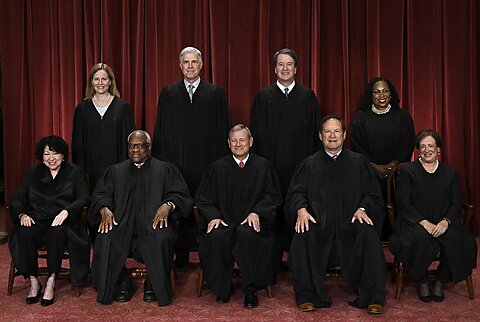

The Supreme Court’s decision to strike down President Trump’s International Emergency Economic Powers Act (IEEPA) tariffs is a welcome victory for constitutional governance and the rule of law. But anyone hoping this spells the end of the administration’s tariff spree should think twice. Even without IEEPA, the president retains ample statutory authority to quickly recreate much of the current trade policy chaos.
Some of these are familiar. During Trump’s first term, he invoked Section 301 of the Trade Act of 1974 and Section 232 of the Trade Expansion Act of 1962 to hit China and impose steel and aluminum tariffs. Yet US law provides other tools that have largely escaped notice. Two lesser-known provisions—Section 122 of the Trade Act of 1974 and Section 338 of the Tariff Act of 1930—could let the administration continue its tariff onslaught even without IEEPA.
What the Court Got Right
Before diving into those statutes, it is worth noting what the Supreme Court got right. When the administration invoked IEEPA to impose sweeping tariffs on nearly all imports, it stretched a 1977 sanctions law well beyond anything Congress intended. IEEPA was designed to let presidents freeze assets and restrict financial transactions during genuine emergencies. The law does not function as a switch in the Oval Office for presidents to unilaterally rewrite virtually the entire tariff code passed by Congress.
The Court’s decision provides practical relief for Americans suffering from the administration’s ill-advised tariffs. Businesses have been whipsawed by tariff rates that changed seemingly by the hour during the spring chaos. The Tax Foundation estimates that the IEEPA tariffs increased taxes on American households by about $1,000 in 2025 and will tack on another $1,300 in 2026. The unpredictability, especially for small businesses, was almost as damaging as the rates themselves.
But the end of the IEEPA tariffs does not mean an end to unilateral trade policy. The administration has already been eyeing other, largely overlooked statutes that could produce a similar result.
Section 122
Faced with a possible Supreme Court defeat over IEEPA, administration officials have been readying alternative authorities under which to impose tariffs. One such statute is Section 122 of the Trade Act of 1974. The provision empowers the president to address “large and serious” balance-of-payments deficits through import surcharges of up to 15 percent, import quotas, or some combination of the two. That surely holds considerable appeal for a president who has consistently (and mistakenly) railed against the alleged dangers of US trade deficits.
As Stan Veuger of the American Enterprise Institute and I explained in December in Foreign Policy, the administration could replicate most of the IEEPA tariff structure through Section 122 in short order. Countries currently facing rates above 15 percent would see some reduction, but for every other country, the hit would be nearly identical. And crucially, Section 122 doesn’t require the lengthy investigations that other trade statutes demand. The president could act fast.
But there’s a catch: Section 122 tariffs expire after 150 days unless Congress votes to extend them. How much of a constraint this is, however, remains to be seen. If Congress declines to act, the administration could, at least in theory, allow the tariffs to lapse, declare a new balance-of-payments emergency, and restart the clock. The maneuver would raise serious separation-of-powers concerns, but nothing in the statute clearly forbids it.
With the statute never previously invoked, there’s no judicial precedent clarifying its limits.
Section 338
There’s also Section 338 of the Tariff Act of 1930 (the infamous Smoot-Hawley Act) that, like Section 122, has never been deployed. It authorizes the president to impose tariffs of up to 50 percent on imports from any country that “discriminates” against US commerce as compared to other nations.
The statute is remarkably short and vague. It assigns a role to the US International Trade Commission (USITC), which has a duty to “ascertain and at all times to be informed” whether discrimination is occurring and to “bring the matter to the attention of the President, together with recommendations.”
But whether this functions as a procedural prerequisite or merely an advisory channel is unclear. The statute separately authorizes the president to impose tariffs “whenever he shall find as a fact” that discrimination exists. Does that language empower the president to act unilaterally, or must he await Commission findings? The text doesn’t say.
The Congressional Research Service has suggested that Section 338 falls into a category of tariff authorities that “do not contain” requirements for a federal agency to “conduct an investigation and make certain findings before tariffs may be imposed.” But this interpretation has never been tested by any administration or any court.
And what counts as discrimination in the first place? The law doesn’t say with any precision. Proving discrimination could be challenging when targeting World Trade Organization members bound by most-favored-nation requirements. Or would it? The administration could argue that any country maintaining tariffs on American goods—or any country with trade practices the president dislikes—is “discriminating” against US commerce.
The United States threatened to invoke Section 338 several times during the 1950s to advance foreign policy goals, but never followed through. The statute hasn’t been meaningfully tested in modern courts, which means its boundaries remain undefined. Would courts defer to an aggressive interpretation of the president’s authority? Would they require USITC involvement? No one knows. For an administration intent on maximizing its discretion, that ambiguity could be a feature, not a bug.
The Underlying Problem
Unfettered use of Sections 122 and 338—along with better-known statutes like Sections 301 and 232—could essentially recreate the IEEPA predicament. In practice, this means the president can continue reshaping tax policy and the business environment on a whim, redistributing hundreds of billions of dollars and imposing pervasive uncertainty, without express congressional authorization.
The Court did important work by reining in the misuse of IEEPA. But judicial intervention can only go so far. Congress spent decades handing off its constitutional trade authority to the executive branch, and these delegations remain largely intact. Until lawmakers reclaim some of that authority and add serious procedural safeguards, the risk of arbitrary tariffs will continue.
The Court did its job. Now Congress needs to do its own.