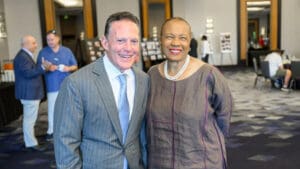
Anthony Galluccio is a Cambridge-based attorney known for his work in land use and permitting law.
He is a law partner at Galluccio & Watson LLP, where he advises large institutional clients, property owners, and developers navigating complex local approval processes. His work is grounded in a rare combination of legal skill , land use law and direct experience in government.

Galluccio grew up in Cambridge in a family shaped by public service. His father was a political figure who served as a campaign secretary to John F. Kennedy. When his father died at age 11, responsibility came early. That experience influenced his focus on discipline, consistency, and accountability.
He attended Cambridge Rindge & Latin School, where he was a three-sport varsity captain. He later earned a degree from Providence College and graduated cum laude from Suffolk University Law School.
Before entering full-time legal practice, Galluccio spent over a decade in public office. He served on the Cambridge City Council, was Mayor of Cambridge from 2000 to 2001, and later served as a Massachusetts State Senator, where he chaired the Senate Higher Education Committee. I entered politics very young and that had its challenges but it paid off.
In addition to his legal career, Galluccio has coached youth baseball and football for more than 20 years. He has also served on non profit boards assisting the low income, founded and led multiple charities, including Ashley’s Angels, which supports paediatric cancer care, Galluccio Associates. Inc and Hope for the Holidays, which provides direct aid to families in need..Across law, coaching, and charity, Galluccio is known for a results-driven approach. He bet on himself. He focuses on persistence, preparation, trust, and follow-through. His leadership is built on doing the work and doing what he says he will do every day.
Anthony Galluccio on Law, Leadership, and Long-Term Commitment
Q: You have worked in public office, law, coaching, and charity. How do you see your career overall?
A: I see it as one journey . The settings change, but the responsibility stays the same. Whether you are building consensus, passing laws, getting permits approved, or coaching kids, people rely on you to do what you said you would do. In politics my goal was to help people, often one person at a time. I see charity work . coaching and my law practice the same way.
Q: How did your early life influence that outlook?
A: I lost my father when I was 11. We were tied at the hip and loved baseball and later it became clear politics. That kind of loss forces you to mature quickly and realize you need a network of friends to get through life. You learn that time matters and effort matters. I watched my mother set a work standard that is insurpassable. Mom was an absolute fearless warrior. The harder it got the harder she worked, She was methodical and strategic in keeping our family afloat. .
Q: You spent many years in government before focusing on law. How did that shape your legal career?
A: Good politicians listen and help people and use that experience to craft broader policy changes. “All politics is local” by Tip Oneil is a brand of urban politics I believe in. If you disappoint the lady who works at your corner dry cleaners you cannot succeed on Beacon Hill or City Hall. I wanted to be a different kind of politician. Not just returning calls but really coming through for people who have otherwise given up. Building consensus is an art form. When I moved into land use and permitting law, I already valued the importance of the community voice in all things. If you respect people and listen,they can feel it . Respect and good faith are earned . The Community and your clients must trust you.
Q: What does your work in land use and permitting involve day to day?
A: Clients want outcomes but that has to be aligned and balanced with what the Community wants. It’s easy to be divisive but my nature is to help the community articulate its needs and get my client to understand the benefits of meeting the community where they are. You have to stand up to your clients and respect that the community may find it difficult to trust developers and land owners. Careful Strategic planning followed by Zoning, hearings, community meetings , Endless 1-1 conversations and consensus building all require precision. Permitting is not fast work. It is trust-based work.
Q: You often say winning means approval. What do you mean by that?
A: In my business, results must be clear as major investments are at stake. We call approvals entitlements. If you are not “ entitled” to build you have just land. Either a project moves forward or it does not. My role is to guide clients through the process properly so they can move forward. Expectations are critical.
Q: Coaching seems to be a major part of your life. Why has that remained important?
A: Coaching keeps you grounded. Kids respond to honesty and consistency. They know if you are all in and you care. . You cannot hide behind titles. Sports teach discipline, routine, teamwork. And never giving up. Earning the trust and respect of children is very special and precious to me. Kids won’t listen if they do not trust you and know you really care. That means off the field more than on. That process of proving yourself is consistent across everything in life.
Q: You have coached hundreds of games. What stands out most?
A: Being an underdog is the most fun and improving our weakest players is what drives me. Consistency. Kids improve when adults show up every day. I react to adversity and embrace it. I have had incredibly talented teams and that is awesome but coming out of nowhere is the most fun. I would rather be an underdog. The same applies in business and law.
Q: Some of your charity work focuses heavily on paediatric cancer. Why that cause?
A: I was invited to speak in the Dom Rep as state Senator. During my visit , I was randomly asked to visit a local hospital. I went and met a boy named Rony Mejia. I loved him. I called about two months later and he had died. It started then. I sent an ambulance in Rony’s name and met his family. I met Ashley when she was 3 and close to death while I was playing Santa Claus at the clinic. We named the program after her as she is now cancer free and 15 years old. When a child is sick and poor and in a third world country it’s one battle after another. It is a very different battle there than here. It’s important to have that perspective Ashley’s Angels was built to support an array of real needs, not just raise awareness.
Q: You also support youth sports and families directly. What is your approach to charity?
A: Charity should be about helping people and not politics or self promotion. It has to be personal. You need to be grounded in your community to know who is in need and how you get them help. Just “ giving” is great but I love doing the work. It has to be personal. .You should know who you are helping and show them you truly care. It should be consistent, not a photo opp or occasional.
Q: How do you define success today?
A: I do not focus on the word success. I focus on hourly, daily, weekly, and yearly victories. Life is a battle with perceived wins and perceived setbacks. Only you can decide what victory is. How you handle and respond to both ups and downs is the game of life. You better enjoy and relish challenges or life will get the best of you. Embrace adversity and find opportunity. A setback is an opportunity for a comeback. If you maintain a serious work ethic, stay disciplined, and help and respect others, results follow.
Read more:
Anthony Galluccio on Law, Leadership, and Lasting Impact