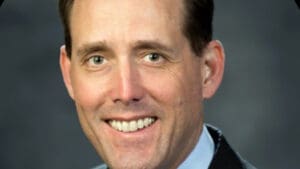
John Foster is a respected lawyer and public sector legal leader with more than thirty years of experience in government and education law.
He grew up on military bases across the United States, where a childhood shaped by discipline, duty, and resilience set the tone for his career. His father was a decorated Marine Corps officer, and his mother was an English immigrant who survived wartime evacuation before building a long career as a paralegal.

John studied History and Foreign Affairs at the University of Virginia before earning his law degree there in 1992. He began his career as a senior attorney in private practice, where he developed strong skills in litigation and client advocacy. In 1999, he moved into public service as an Assistant County Attorney for Fairfax County. He later became City Attorney for the City of Falls Church, guiding major decisions and providing steady leadership through complex issues.
Since 2013, John has served as General Counsel for Fairfax County Public Schools, one of the nation’s largest school systems. In this role, he manages legal strategy, advises leadership, and supports decisions that affect thousands of families. He is AV-rated (preeminent) by Martindale-Hubbell and serves on the Virginia State Bar Council.
Beyond his legal work, John is a committed long-distance cyclist who enjoys exploring rural and remote areas on gravel and mountain bikes. He also remains active in community leadership, including past service as president of Christ Lutheran Church in Fairfax. His career reflects a consistent dedication to service, integrity, and clear decision-making.
Q&A with John Foster
You grew up on military bases. How did that shape your approach to work and leadership?
Growing up on bases meant change was constant. We moved often—California, Hawaii, Virginia. Discipline was everywhere. I watched my father lead Marines and my mother rebuild a life after the war. That taught me to stay calm under pressure and to stay focused on the bigger picture.
Your mother survived wartime evacuation in England. Has her experience influenced your outlook?
Very much. She was sent out of London as a child during the bombings. She lost close family members. Yet she came to the United States, became a citizen, and worked as a paralegal for forty years. Her resilience shaped how I think about setbacks. She showed me you keep going, even when the path isn’t easy.
What drew you to studying History and Foreign Affairs at university?
I’ve always been drawn to the way institutions and governments interact with people. History teaches you about consequences. Foreign Affairs shows how decisions ripple outward. It was a strong foundation for studying law.
What did your early years in private practice teach you?
Private practice taught me how to prepare thoroughly. As a senior attorney, I learned to manage complex matters and to support clients through stressful moments. It was good training for the responsibility that comes with public sector work.
You spent nearly a decade with Fairfax County Government. What stands out from that period?
Local government is where real decisions meet real communities. You see how policies affect people directly. It gave me a strong sense of accountability, and it taught me to balance legal requirements with practical realities.
Your time as City Attorney for Falls Church placed you in a key leadership role. What was that transition like?
It was a shift from advising on issues to leading broad legal strategy and solving the long-running “water wars” with Fairfax County. You’re responsible not just for answers, but for creating clarity. I learned to communicate more directly and to anticipate challenges before they reached the surface.
You now serve as General Counsel for Fairfax County Public Schools. What makes this role unique?
It’s one of the most complex environments in public law. Schools involve policy, operations, public expectations, and thousands of students and staff. You have to stay steady, especially when issues become highly visible. The work matters because the outcomes affect the entire community.
You’re AV-rated by Martindale-Hubbell and serve on the Virginia State Bar Council. What do those roles mean to you?
They’re reflections of professional trust. The rating comes from peers and judges, so it means a great deal. Serving on the Bar Council allows me to contribute to the future of the profession, which I take seriously.
Outside work, you’re a long-distance cyclist. What does cycling give you that the legal world does not?
Cycling takes you away from everything for a while. When you’re deep in rural Virginia or on a remote gravel trail, you’re not thinking about emails or policies. It resets your mind. You have space to breathe, and that helps you return to work sharper.
What advice would you give someone entering public sector law today?
Learn to listen. Understand the weight of your decisions. And remember that public service is exactly that—service. You won’t always be in the spotlight, but the work you do will make a difference.
Read more:
In Conversation with John Foster Fairfax