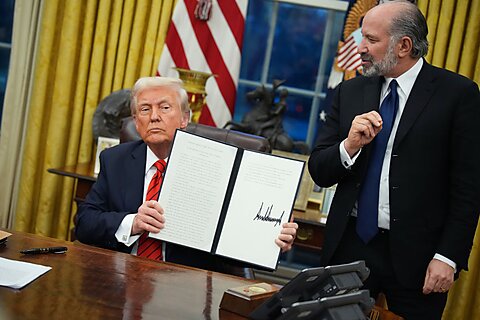

In an interview with the Wall Street Journal over the weekend, the president confirmed that he’s considering taking equity stakes in defense companies—“he” being the federal government.
Trump was then quoted as saying:
We should take stakes in companies when people need something. I think we should take stakes in companies. Now, some people would say that doesn’t sound very American. Actually, I think it is very American.
Let that sink in: We should take stakes in companies when people need something.
In a recent essay for The Dispatch, I discuss the concerns surrounding the series of deals the administration has struck over the past six months that have given the federal government ownership stakes in a portfolio of private companies. In the past, the government has taken equity and warrant positions on plausible emergency grounds, with the intention of offloading the stakes after the emergency subsided. That’s not what’s going on here.
So, no, what the administration is doing is not very American. Russian or Chinese, yes.
Various labels have been used to describe the administration’s novel approach to American economic policy. The Wall Street Journal’s Greg Ip refers to it as state capitalism. Reason’s Eric Boehm calls it socialism. My colleague Scott Lincicome says state corporatism. And the American Enterprise Institute’s Tim Carney came up with the clever venture socialism.
For Trump, however, it simply boils down to his transactional mindset and disregard for the remaining constraints on executive power. In his mind, the federal government is literally his business. As the sophomoric “when people need something” rationale given to the Journal demonstrates, there’s no substantive guiding philosophy at work here. Indeed, the deals themselves have been made seemingly ad hoc, with little evidence of any serious due diligence having been performed or potential negative consequences considered.
In the essay, the following points are made:
The administration has assembled (and continues to expand) a portfolio of equity stakes and profit-sharing deals across “strategic” industries.
The agenda is best understood as a deal-by-deal executive leverage over private firms, regardless of what label is applied to it. It’s about power and control.
The seed was planted by a February executive order to plan a US sovereign wealth fund (SWF), a bad idea in itself.
In practice, there’s no real SWF: the administration is trying to use shakedowns of companies and countries to finance a pseudo-SWF under presidential control—sidestepping constraints that would come with actual legislation passed by Congress.
When the federal government becomes an owner, corporate decisions can shift toward political incentives rather than market-driven ones.
Equity stakes and warrants create favoritism risk by encouraging markets to treat politically connected firms as preferred “winners.” One winner is top Trump adviser Stephen Miller, who made a tidy profit after selling shares of MP Materials, which the administration had taken ownership stakes in just a month prior.
Government ownership can undermine the stated national security rationale by spooking foreign customers and regulators, and by increasing future bailout pressures if things go wrong.
The “taxpayers should share the upside” argument is overstated: investment returns won’t move the needle relative to federal spending, and equity can go down. My colleague Tom Firey wrote about the latter being a possibility with the Westinghouse deal.
Conventional policy tools are available to address concerns about supply chain security. Equity stakes are at best unnecessary.
Reducing regulatory bottlenecks, such as long permitting timelines, is necessary to expand domestic supply, which the administration—to its credit—is pursuing.
Tariffs and other trade restrictions raise costs and strain allied supply chains. If China’s the primary concern, that makes no sense.
The Republican Congress has largely stood idly by, similar to its limited pushback against executive branch tariff overreach.
Unless Congress intervenes, the tools and precedents being established will be available to future administrations.
Normalizing government shareholding invites future presidents to use ownership leverage to pressure corporate behavior. Republicans should consider what that might look like under a Democratic president.
On August 7, the president saw a segment on Fox Business Network about Intel Chairman Lip-Bu Tan’s past work at a chip-design company. The company had recently agreed to pay a hefty fine for selling banned technology to a Chinese national defense university. According to the Wall Street Journal, Trump called for Tan’s resignation five minutes later on his Truth Social platform. A few days later, Tan flew to the White House for an audience with the president. That following week, Trump announced that a deal had been reached for the federal government to become Intel’s largest shareholder.
On Monday, Bloomberg reported the following:
Intel Corp. named Robin Colwell as senior vice president of government affairs, enlisting a Trump administration official to oversee the chipmaker’s relationship with policymakers and regulators. Coldwell had served as deputy assistant to President Donald Trump and deputy director of the National Economic Council. She will remain in Washington as part of the new job, Intel said in a statement Monday.
To reiterate, when the federal government becomes an owner, corporate decisions can shift toward political incentives rather than market-driven ones.
(Note: Readers interested in, but unable to access, the essay are welcome to contact me.)