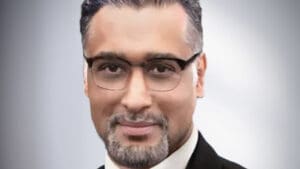
Sir Patrick Bijou is a seasoned investment banker and fund manager with more than three decades of experience in global finance.
Born in Georgetown, Guyana, and raised in the United Kingdom, he built his career through steady determination and a deep interest in economic systems. After earning degrees in Business Studies, Economics, and International Banking, he moved to New York and secured his first role at Wells Fargo on Wall Street. There, he learned the discipline of structured finance and the fast pace of the trading floor.

His career expanded across major financial institutions, including Deutsche Bank, Merrill Lynch, Credit Agricole CIB, Calyon, Lloyds Bank, and BlackRock, where he served as a Director. He became known for his expertise in debt capital markets, derivatives, private placement, and fund management. One of his early milestones was helping establish the MTN and Private Placement Desk at Lloyds Bank, increasing self-led deals from 4% to 32%.
Sir Patrick also founded The Tiger Fund and later launched Blackhorse International and Westpac Trading FZE, leading both with a focus on strategy, stability, and long-term planning. His work spans the UK, USA, UAE, Singapore, and beyond. He is widely regarded as a global authority on Private Placement Programmes and has written best-selling books on the subject.
Knighted for his contributions to banking and philanthropy, Sir Patrick continues to support humanitarian causes, from building irrigation systems in Sierra Leone to providing housing for vulnerable children. His career reflects a consistent belief: finance should create progress, not just profit.
Q&A With Sir Patrick Bijou
You moved from Guyana to the UK at a young age. How did your early life help shape your interest in finance?
I grew up in Britain after my father earned a scholarship, and it gave me a strong respect for education and discipline. From a young age, I was curious about how economies worked. When I studied Business Studies and later Economics and International Banking, that curiosity became a real path. It taught me that numbers are not just numbers. They tell a story about people, stability, and opportunity.
What led you to Wall Street and your first role at Wells Fargo?
I moved to New York for 14 years during my studies. My first role was at Wells Fargo. I began as a personal banker and later moved to the trading floor. It was intense, but it taught me consistency. I often say, “If you can stay steady when markets shift, you make better decisions.” Those years built the foundation for everything that followed.
You later worked across several major institutions. What were some defining moments?
Each institution taught me something different. At Lloyds Bank, I helped build the MTN and Private Placement Desk. We increased self-led deals from 4% to 32%, and that showed how structure and small adjustments can change results on a large scale. At Credit Agricole CIB and Calyon, I worked on interest rate derivatives and structured products. At BlackRock, I gained a broader view of how global markets connect.
You are known as an authority in Private Placement Programmes. How did that specialism evolve?
It came from years of seeing the gaps between capital needs and traditional funding routes. Private placement became a way to bridge that. Over time, I developed strategies for governments, institutions, and private clients. I later wrote books about it because people wanted accessible explanations. Writing allowed me to share insights without the complexity that often scares people away.
You founded several companies, including Blackhorse International and Westpac Trading FZE. What inspired your move into leadership roles?
After decades in banking, I understood the value of building something with long-term vision. Leadership is not about noise; it is about reliability. I launched companies to create space for innovation and to build teams that could think beyond immediate pressures. And because we operate across the UK, USA, Singapore, and the UAE, we can see global trends in real time.
Your work has also taken you into humanitarian efforts. How does that connect with your career in finance?
Finance and humanitarian work are more connected than people think. I have seen how unstable economies can lead to political unrest. I once supported peace efforts during genocides in Africa, and experiences like that stay with you. I believe “success is not defined by wealth but by contribution.” That is why I support irrigation projects in Sierra Leone, housing for children in India, and hospitals like Great Ormond Street.
Why do you speak often about narrowing the wealth gap?
Because the numbers are stark. The richest 1% hold nearly half of global wealth. When that gap grows, societies become unstable. Capitalism can help solve this if guided correctly. I want people to see that economic growth and social good do not have to be opposites.
What role does writing play in your work?
Writing began as a hobby. Over time it became a platform. Books like Private Placement Programmes: The Holy Grail allow me to share clear explanations. I believe “one never stops learning,” and writing keeps me sharp while giving others a resource.
What guidance would you share with future leaders in finance?
Be steady. Be curious. And be aware that every decision has a human consequence. Finance is powerful, but it should be used responsibly. I always say, “There is always a way forward if we innovate responsibly.” That mindset has carried me through every challenge.
For more on his work, visit Sir Patrick Bijou.
Read more:
Insights From a Global Career: A Conversation With Sir Patrick Bijou